Shevek’s illness and reunion with Rulag
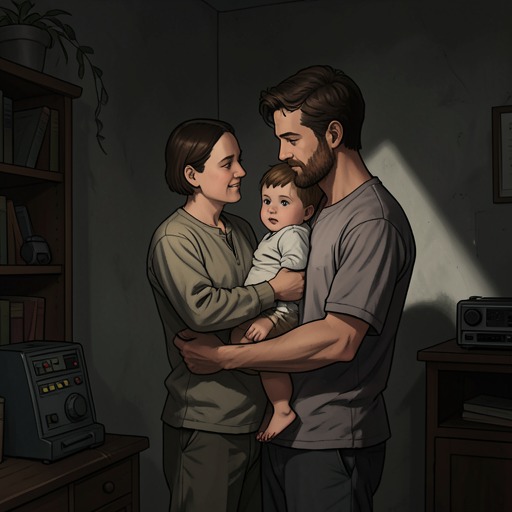
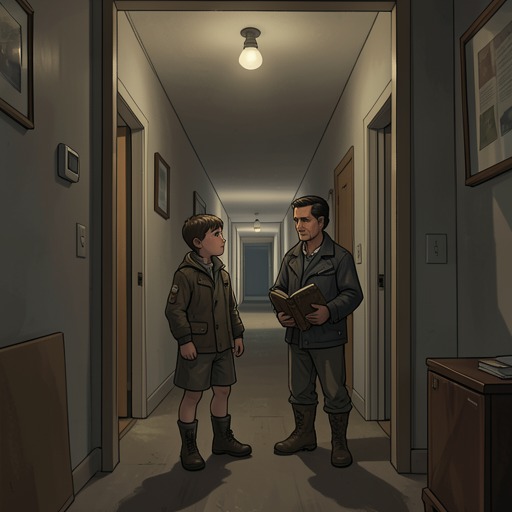
The DispossessedShevek’s illness and reunion with Rulag brings his estranged mother to his bedside at a moment when fever has left him physically helpless and uncertain of his own mind. Their meeting turns a clinic visit into a confrontation with the childhood he remembers only through Palat’s care: Rulag describes a past in which she and Palat both wanted to raise him, but Shevek cannot accept that history as a relationship he experienced. The scene ends not with reconciliation but with his renewed sense that promises and time have broken apart.
Illness and Vulnerability
After walking through a cold rain in Abbenay, Shevek reaches his room shaking uncontrollably and wraps himself in an orange blanket. The fever and headache are unfamiliar enough to frighten him; during lucid intervals, he mistakes his illness for the onset of insanity. Rather than ask his neighbors for help, he drags himself to a clinic eight blocks away. There, the staff diagnose light pneumonia and admit him to Ward Two, where the other patients are old.
The physical crisis strips away the composure with which Shevek has tried to accommodate his working life in Abbenay. He has been telling himself that his duty and joy lie in doing his work, even though the man he must work with is competitive and seeks dominance. In the ward, however, he has little control over his body or surroundings: he is shaking, suspicious of the offered medicine, and dependent on care. That vulnerability sets the terms of the reunion. Rulag encounters not the capable young theorist she has discovered in print, but a son who is ill and has never known her as a mother.
The Recognition
Rulag’s presence first reaches Shevek through the intimate certainty of her voice and touch. When she tells him that he has no fever and touches his forehead, the words reverberate through a deep, walled-off place in him. He looks at her in terror and recognizes her as Rulag, despite her insistence that she has already told him who she is. He recoils weakly, as though she were death rather than his mother. Her controlled expression gives no sign that she responds to his fear.
She is in Abbenay because she found a new book by Sabul and Shevek while looking through publications at the Press depot for the Engineering library. She recognized the name only after a pause: the Shevek she remembered should have been about twenty, too young to be co-authoring a treatise in metacosmology, but another Shevek would have been younger still. She came to the clinic after learning from someone in the domicile that he was there. The printed book has thus carried his name to the mother who lost track of his life, making intellectual achievement the accidental path back to a family encounter.
Rulag speaks about the clinic as an engineer concerned with its understaffing. She questions why the syndics have not requested more medical postings or reduced admissions, and criticizes self-sacrificing work when it does not produce maximum efficiency. Her comments reveal both her practical attention to institutional arrangements and the priority she gives to work. Even at her son’s bedside, she approaches the clinic partly through the problem of how it is organized.
Palat and the Broken Family History
When Rulag asks whether Shevek and Palat are in touch, Shevek answers that Palat is dead. Her response carries no show of shock or grief, only bleak, weary recognition. For a moment, that sorrow allows Shevek to see her as a person rather than simply as the mother who left. The exchange brings Palat’s absence into the room before the two can address what separated mother and son.
Rulag asks whether Shevek resents her for not keeping in touch. His answer is that he never knew her. She counters that she did live with him and Palat in a domicile even after he was weaned, and says both parents wanted him. In her account, those early years mattered because affection was thought essential to an individual’s development; she also says that she was willing to continue the partnership. She had tried to have Palat posted to Abbenay, but there was no opening in his line of work, and he would not come without one. At first, she says, he wrote to tell her how Shevek was; eventually he stopped.
Her account does not erase the years Shevek experienced without her. Rulag says that Palat stayed with him through his formative years and was supportive and parental, while she was not. She states plainly that work has always come first for her. She is glad to find Shevek in Abbenay and offers to introduce him to interesting or useful people, as well as to help him navigate Sabul and the Institute’s dominance games. Yet her offer does not restore the parental bond she describes. Shevek hears in her loneliness and pride a claim on a relationship he feels he has never had.
Rejection and Aftermath
Rulag tells Shevek that she read the book and is proud of him, while recognizing the possessiveness in feeling pride as though he belonged to her. She admits that people grow older and need reassurances that may not be entirely reasonable. Her candor exposes an emotional need that Shevek cannot meet. Seeing her loneliness and pain, he resents them: they threaten the memory of Palat’s constant loyalty, the love in which Shevek believes his life took root. He asks what right she has, after leaving Palat in need, to come to Palat’s son in her own need. He says he has nothing to give her or anyone, and tells her it might have been better if she had continued to think of him as a statistic.
Rulag answers softly and looks away. After sitting in silence, she tells him to rest, says the staff expect him to recover, and doubts she will return. She says goodbye and walks out with measured composure, stopping in the hall to speak smilingly with an aide. Shevek glimpses—or imagines in a nightmare—the possibility that her face has broken down as she speaks. The narration leaves that collapse uncertain, while making his own distress unmistakable.
Once she has gone, Shevek gives way to the fear her presence has awakened: a sense that promises have broken and time no longer holds together. Unable to turn over, he hides his face in his arms and cries. One of the old men in the ward sits beside him and pats his shoulder, calling him brother and little brother and assuring him that things will be all right. Shevek hears and feels the gesture but receives no comfort. The encounter has briefly allowed him to see Rulag’s pain, but recognition alone cannot overcome the distance between her remembered intention and his lived childhood. The episode closes in the dark at the foot of the wall, with a stranger’s offered solidarity unable to repair the family bond that the reunion has exposed.